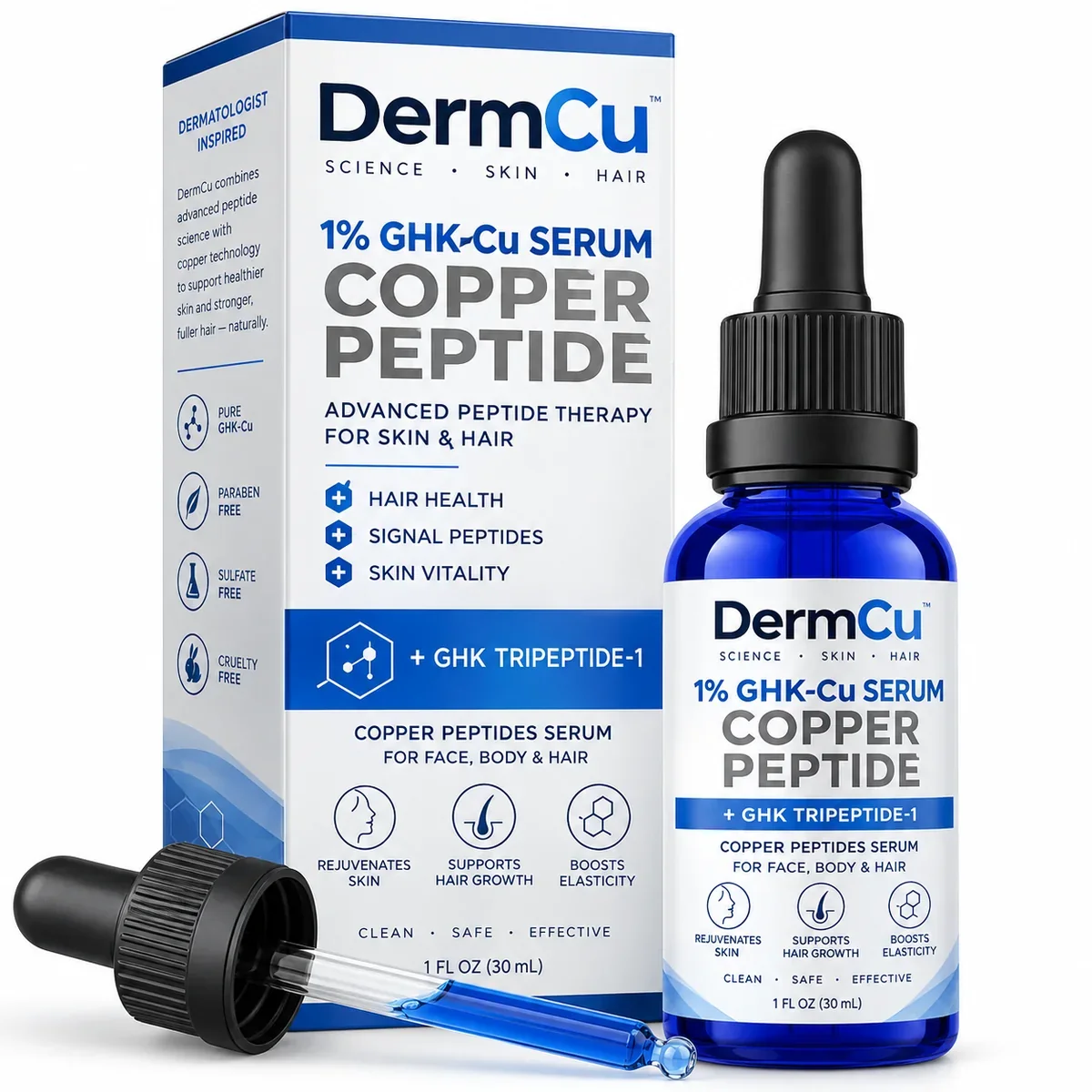
Copper peptide serum (GHK-Cu) for skin
A topical cosmetic serum built around GHK-Cu (copper tripeptide-1) to support the look of firmer, smoother, more radiant skin.
Purchase option
- GHK-Cu (copper tripeptide-1) — cosmetic serum
- Topical skincare — for the look of your skin
- Ingredient-transparent formulation
- Ships across the US
- GHK-Cu (copper tripeptide-1) cosmetic serum
- Topical skincare — for appearance
- Ingredient-transparent formulation
- Ships across the US
Not in stock yet. Join the waitlist — tell us how many you'd want and we'll email you when it's available. No charge now.
What copper peptides (GHK-Cu) are for skin
GHK-Cu is a small copper-binding peptide that occurs naturally in the body and is used as a cosmetic ingredient (listed as copper tripeptide-1) in serums and creams.1 In skincare, it's included in formulas aimed at the look of aging skin. As a cosmetic, a copper peptide serum is intended to improve the appearance of skin — not to treat any medical condition.
What a copper peptide serum is used for
In a skincare routine, people use a GHK-Cu serum for the appearance of:
- fine lines and the look of wrinkles
- skin firmness and a smoother-looking surface
- overall radiance and a more even-looking tone
These are cosmetic, appearance-based goals. A cosmetic serum supports how skin looks; it isn't a medicine and doesn't treat skin conditions.
How to use it
Apply a copper peptide serum topically as part of a normal skincare routine — typically to clean, dry skin, followed by a moisturizer. Patch-test first if your skin is sensitive, since copper-peptide products can occasionally cause irritation or redness.1 Follow the specific product's directions, and introduce it gradually.
The honest pros and cons
Board-certified dermatologists describe copper peptides as a scientifically grounded, low-irritation ingredient — but not a miracle, and not a retinol replacement. Here's the balanced picture.
What's genuinely good about it
- Low irritation compared with many actives — no peeling phase, no added photosensitivity.2
- Supports the look of firmer skin and smoother fine lines with consistent use over roughly 8–12 weeks.2
- A long history of study in skin and skin-repair biology gives it a real mechanistic basis, and it pairs well with a retinol routine.2
The honest limitations
- Copper peptides are large, water-loving molecules that don't cross the skin barrier easily, so formulation and delivery matter a lot.3
- Human anti-aging trial evidence is thinner than for retinol; much of the data is from cell studies and skin-repair research.3
- Copper oxidizes, so a poorly formulated or clear-bottle product can degrade — packaging and stability matter.3
- More is not better: introducing it too aggressively can cause irritation, so start slow.2
Who should be cautious
Anyone with a known copper allergy or Wilson's disease should avoid copper peptides, and during pregnancy it's best to check with a doctor before adding any new active.2
A cosmetic, not a drug. Topical copper peptide serums are cosmetics that support the appearance of skin. They are not intended to diagnose, treat, cure, or prevent any disease, and cosmetic use is separate from any medical or injectable use of copper peptides.1 If you have a skin condition, see a qualified professional.
Frequently asked questions
What does a copper peptide serum do?
As a cosmetic, it supports the appearance of firmer, smoother, more radiant skin. It's a skincare product for how skin looks, not a medical treatment.
Is GHK-Cu the same as copper peptides?
GHK-Cu (copper tripeptide-1) is the specific copper peptide most commonly used in skincare, so "copper peptide serum" and "GHK-Cu serum" usually mean the same thing.1
Is a topical copper peptide serum legal to buy?
Yes. Topical GHK-Cu is sold over the counter as a cosmetic ingredient. That's a separate category from any injectable form.1
How often should I use it?
Follow the product's directions. Many serums are used once or twice daily; start gradually and patch-test if your skin is sensitive.
- Copper tripeptide-1 (GHK-Cu) as a cosmetic ingredient — safety and cosmetic use. PubMed / U.S. National Library of Medicine. View research.
- A dermatologist's view of copper peptides (GHK-Cu): benefits, low irritation, cautions, and dose. Westlake Dermatology (board-certified dermatology). View article.
- Copper peptides for skin: penetration, clinical-evidence and stability limitations. North Biomedical review. View review.